Jason Wagner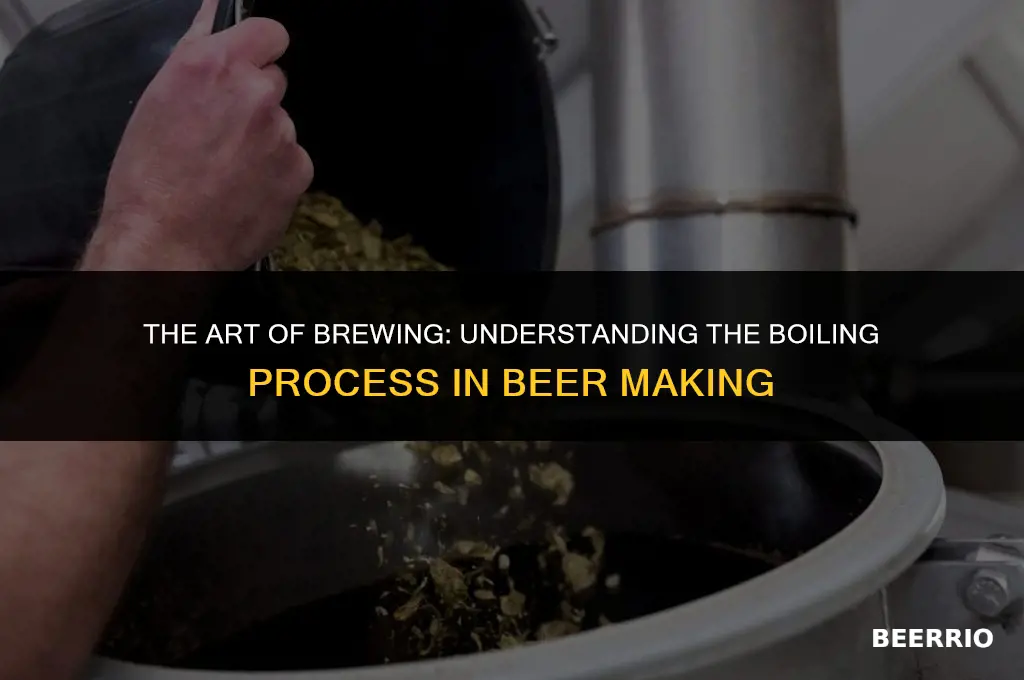
The boiling process in brewing beer is a crucial step that involves heating the wort—the liquid extracted from mashing grains—to a specific temperature for a set period. This process serves several key functions: it sterilizes the wort, halting bacterial growth; it helps to develop the beer's flavor profile by isomerizing the alpha acids in hops, which contributes to bitterness; and it allows for the removal of unwanted compounds that can affect the final taste. Typically, boiling occurs in a large kettle and lasts between 60 to 90 minutes, during which time brewers may add hops at different intervals to achieve the desired balance of flavors. After boiling, the wort is cooled and then fermented with yeast to produce alcohol and carbonation, ultimately transforming it into beer.
Explore related products


What You'll Learn
- Mashing: Combining milled grain with hot water to convert starches into fermentable sugars
- Boiling: Heating the wort to sanitize it and add bitterness through hops
- Hops Addition: Introducing hops at various stages for flavor, aroma, and preservation
- Cooling: Rapidly lowering the wort temperature to prepare for yeast addition
- Fermentation: Yeast converts sugars into alcohol and carbon dioxide, creating beer

Mashing: Combining milled grain with hot water to convert starches into fermentable sugars
Mashing is a critical step in the beer brewing process where milled grain is combined with hot water to convert the starches present in the grain into fermentable sugars. This process is essential for creating the wort, which is the liquid that will eventually be fermented into beer. The mashing process typically takes place in a mash tun, a large container that can hold the grain and water mixture at a consistent temperature.
The temperature at which the mashing occurs is crucial, as different temperatures can affect the types of sugars that are produced. For example, lower temperatures tend to produce more complex sugars, while higher temperatures can lead to simpler sugars that ferment more quickly. Brewers often aim for a temperature range between 150°F and 155°F (65°C to 68°C) to achieve a balance of sugar types.
During mashing, enzymes naturally present in the grain, such as amylase, break down the starches into sugars. This enzymatic activity is highly dependent on temperature and pH levels. Brewers may also add additional enzymes to the mash to ensure a more complete conversion of starches to sugars.
The duration of the mashing process can vary, but it typically lasts between 30 minutes to an hour. After mashing, the mixture is usually lautered, which involves separating the liquid wort from the solid grain material. The wort is then transferred to a kettle for the boiling process, where hops and other ingredients are added to create the final beer flavor.
One common mistake in the mashing process is not achieving the correct temperature, which can lead to incomplete starch conversion and ultimately affect the taste and quality of the beer. Brewers must also be careful to avoid over-mashing, as this can result in a wort that is too thin and lacks the necessary sugars for proper fermentation.
In summary, mashing is a vital step in beer brewing that involves combining milled grain with hot water to convert starches into fermentable sugars. The process requires careful control of temperature, pH, and duration to ensure a successful outcome. By understanding the intricacies of mashing, brewers can create a high-quality wort that will ultimately lead to a better-tasting beer.
Exploring Singapore's Inaugural Brew: A Taste of Local Craftsmanship
You may want to see also
Explore related products


Boiling: Heating the wort to sanitize it and add bitterness through hops
The boiling process in brewing beer is a critical step that serves two main purposes: sanitization and the addition of bitterness through hops. This stage involves heating the wort, which is the liquid extracted from the mashing process, to a high temperature to kill off any bacteria or wild yeast that could spoil the beer. The boiling process typically lasts for about an hour, during which time hops are added at different intervals to contribute varying levels of bitterness, flavor, and aroma to the final product.
One of the key considerations during the boiling process is the timing of hop additions. Hops added early in the boil contribute more bitterness, while those added later provide more flavor and aroma. Brewers often use a combination of early, middle, and late hop additions to achieve a balanced profile. The amount of hops used can vary greatly depending on the style of beer being brewed, with India Pale Ales (IPAs) typically requiring more hops than lagers or stouts.
Another important aspect of the boiling process is the control of temperature. While the wort needs to reach a high temperature to ensure proper sanitization, it is also important to avoid overheating, which can lead to the formation of unwanted compounds and off-flavors. Brewers must carefully monitor the temperature and adjust the heat source as needed to maintain the desired level.
In addition to sanitization and bitterness, the boiling process also plays a role in the development of the beer's color and clarity. The heat causes the wort to caramelize, which can contribute to the beer's color, and also helps to coagulate proteins and other particles, leading to a clearer final product.
Overall, the boiling process is a complex and crucial step in brewing beer, requiring careful attention to detail and a good understanding of the underlying principles. By mastering this stage, brewers can ensure that their beer is not only safe to drink but also has the desired flavor, aroma, and appearance.
Exploring New Glarus Brewing's Finest: A Beer Enthusiast's Guide
You may want to see also
Explore related products


Hops Addition: Introducing hops at various stages for flavor, aroma, and preservation
Hops are a crucial ingredient in beer brewing, contributing to flavor, aroma, and preservation. The process of adding hops at various stages of brewing is known as "hopping." This technique allows brewers to extract different characteristics from the hops, depending on when they are introduced.
During the boiling process, hops are typically added at three different stages: early, middle, and late. Early hop additions, made at the beginning of the boil, contribute to the beer's bitterness. The alpha acids in hops isomerize during boiling, creating compounds that give beer its characteristic bitter taste. The longer the hops boil, the more bitterness they impart.
Middle hop additions, made during the middle of the boil, contribute to the beer's flavor and aroma. These additions allow the hops' essential oils and other flavor compounds to be extracted without being lost to evaporation. Late hop additions, made towards the end of the boil or even after fermentation, are primarily used for aroma. These hops are added at lower temperatures, preserving their delicate oils and aromas.
In addition to the timing of hop additions, the amount of hops used also plays a significant role in the final product. Brewers must carefully calculate the amount of hops to add at each stage to achieve the desired balance of bitterness, flavor, and aroma. Factors such as the type of hops, the beer's style, and the desired intensity of hop character all influence these calculations.
The boiling process is a critical step in beer brewing, and the addition of hops at various stages allows brewers to create a wide range of flavors and aromas. By understanding the different stages of hopping and the effects of each, brewers can craft beers that are perfectly balanced and full of character.
Unlocking the Secrets of Secondary Fermentation in Craft Beer Brewing
You may want to see also
Explore related products


Cooling: Rapidly lowering the wort temperature to prepare for yeast addition
Rapid cooling of the wort is a critical step in the beer brewing process, serving as a bridge between boiling and fermentation. This phase, often overlooked, plays a pivotal role in ensuring the health of the yeast and the quality of the final product. The wort, after boiling, is typically at a temperature that is too high for yeast to survive. Therefore, it must be cooled down swiftly to a temperature range that is conducive to yeast activity, usually between 60°F to 75°F (15°C to 24°C).
One common method of cooling the wort is through the use of a wort chiller, which is a device specifically designed for this purpose. Wort chillers come in various designs, but they all function by allowing cold water to flow through a series of tubes or plates that are in contact with the hot wort. This process exchanges heat between the wort and the water, effectively cooling the wort down. Another method, particularly useful for smaller batches, is to place the wort in a sink filled with ice water and stir it continuously. This method, while simple, can be less efficient and may require more effort to maintain a consistent temperature.
It is essential to monitor the temperature of the wort closely during the cooling process to avoid overcooling, which can also be detrimental to the yeast. Once the wort has reached the desired temperature, it should be transferred to a fermentation vessel, and the yeast should be added promptly. The timing of yeast addition is crucial, as it ensures that the yeast can begin fermentation at the optimal temperature, leading to better beer quality and flavor.
In summary, the cooling phase in beer brewing is a vital step that requires careful attention and the right equipment. By rapidly lowering the wort temperature to a suitable range for yeast, brewers can ensure a healthy fermentation process and ultimately produce a high-quality beer.
Kickstart Your Brewing Journey: Top Beer Kits for Newbies
You may want to see also
Explore related products


Fermentation: Yeast converts sugars into alcohol and carbon dioxide, creating beer
Fermentation is a crucial step in the beer brewing process, where yeast plays a pivotal role in transforming sugars into alcohol and carbon dioxide. This biochemical reaction is what gives beer its distinctive flavor, aroma, and effervescence. The yeast, typically added to the wort (unfermented beer) after the boiling process, consumes the sugars present and produces ethanol and CO2 as byproducts. This process can take anywhere from a few days to several weeks, depending on the type of yeast, the sugar content, and the desired beer style.
The boiling process in brewing beer serves multiple purposes, including sterilizing the wort, extracting flavors from hops, and concentrating the sugars. However, it's the fermentation stage that truly defines the character of the beer. Different yeast strains can impart unique flavors and aromas, ranging from fruity and spicy to earthy and funky. Brewers often select specific yeast strains to achieve the desired profile for their beer.
During fermentation, the yeast cells multiply rapidly, creating a frothy head on top of the wort. This head is a sign of active fermentation and helps to protect the beer from oxidation and contamination. As the yeast consumes the sugars, the specific gravity of the wort decreases, and the alcohol content increases. Brewers monitor this process closely, using tools like hydrometers to measure the specific gravity and alcohol meters to determine the alcohol by volume (ABV).
Once fermentation is complete, the yeast cells settle at the bottom of the fermenter, and the beer is transferred to a secondary vessel for conditioning. This stage allows the flavors to mature and the yeast to clean up any residual sugars. The final product is then filtered, carbonated, and packaged for distribution.
In summary, while the boiling process is essential for preparing the wort and extracting flavors, it's the fermentation stage that truly brings beer to life. The interplay between yeast and sugar during fermentation is a complex and fascinating process that ultimately determines the quality and character of the final product.
Exploring the Rich World of Nitro Cold Brew Beer
You may want to see also
Frequently asked questions
The boiling process in brewing beer is a crucial step where the wort (unfermented beer) is heated to a high temperature, typically between 212°F to 220°F (100°C to 104°C), for a period of time. This process serves several purposes, including sterilizing the wort, extracting flavors and aromas from the hops, and concentrating the sugars.
The boiling process in beer brewing typically lasts for about 60 to 90 minutes. However, this time can vary depending on the type of beer being brewed, the size of the batch, and the brewer's specific techniques. Some beers may require longer boiling times to achieve the desired flavor profile or to ensure proper sterilization.
During the boiling process in beer brewing, the hops are added to the wort at different times to extract their flavors, aromas, and bitterness. The alpha acids in the hops isomerize when exposed to heat, which contributes to the beer's bitterness. Hops added early in the boil contribute more bitterness, while hops added later provide more flavor and aroma.
Sterilizing the wort during the boiling process is important to kill any bacteria, yeast, or other microorganisms that could potentially contaminate the beer and affect its taste, quality, and shelf life. Boiling the wort ensures that it is free from these contaminants before the fermentation process begins, which helps to produce a clean and consistent final product.